Illumio
Top 100
Funding
Raised a $225M round on Jun 24, 2021, bringing the total raised amount to $558M.
Returns Calculator
A $10,000 investment at Series A round (2013) would today be worth:
$1,692,308
169×the original amount
Illustrative · based on reported post-money valuations
Top posts
Maria Dobko 🇺🇦
@DobkoMaria
One month ago I joined @illumio as Applied Research Scientist. Today, I’m proud to share that Forrester named it a clear leader in microsegmentation. “Organisations should put Illumio at the top of their shortlist” - Forrester Q3 2024 Huge win! 🎉
Convequity
@convequity
I know, I know, it is Cisco, but it looks like it is having some good innovation now. It has released Hypershield for next-gen network security for hybrid cloud workloads. - Architecture: Hypershield has enforcement nodes and a policy engine, with endpoint-based enforcement consuming minimal CPU resources. It can be accelerated by GPU or DPU on Cisco's new switches and secures hybrid cloud environments. Looks very similar to Illumio. - Nvidia Partnership: Cisco has partnered with Nvidia ($NVDA) to secure AI data center workloads using Nvidia's GPU-accelerated security framework and NIMS (Nvidia Inception Managed Services). - eBPF: The solution is powered by eBPF (extended Berkeley Packet Filter), which Cisco acquired through the Isovalent acquisition. This enables more granular context and less performance impact compared to existing solutions like CrowdStrike ($CRWD). - AI: Hypershield uses AI for automated asset tagging, patching, vulnerability management, and policy simulation to prevent system breakdowns. - Competition: Workload ZTNA or microsegmentation has not seen widespread adoption despite offerings from Palo Alto Networks ($PANW), Zscaler ($ZS), Akamai ($AKAM), and Illumio. Cisco's new design may address barriers to adoption by improving performance and ease of deployment. Although $SPLK is a legacy acquisition, Isovalent and CSCO's new OUtshift group look quite promising.
Tanya Janca | Shehackspurple
@shehackspurple
Yesssss, it’s happening! I’m joining Raghu Nandakumara from Illumio for a LinkedIn Live on a very spicy little topic: You’ve Built a Security Stack. Have You Built a False Sense of Security? Because buying more tools does not magically equal better security. Sometimes it just means you now have more dashboards to ignore. 😅 We’ll be talking about complexity, cyber resilience, and what it actually takes to improve security outcomes. 📅 Tuesday, May 19 ⏰ 9am PT / 12pm ET 📍 LinkedIn Live Come hang out with us! https://t.co/PuQByvjAb9
BoldStocksBabe
@Boldstocksbabe
Check Point Software Nasdaq: $CHKP Check Point and Illumio expanded their partnership to deliver stronger protection against frontier AI-powered attacks. The collaboration combines segmentation, prevention, and AI-era cyber resilience as enterprises face increasingly advanced threat environments. @CheckPointSW Link: https://t.co/wnDCtydRfG #Cybersecurity #AI #CloudSecurity #Stocks
Gokarp
@PLTRs_Palantir
ALGORITHMIC WARFARE: Air Force Unveils Plan to Trust No One (Algorithmic Warfare = Project Maven) The Air Force recently released a document outlining not only its plan to adopt a zero trust cybersecurity framework but also the challenges the service must overcome to make the strategy a reality. Zero trust — as the Air Force strategy stated — is a cybersecurity model “that assumes all connections, regardless of network origin, come from untrusted sources. Access to each resource is only granted after explicitly requesting, establishing and continuously re-verifying confidence in the requestor’s identity, device and context of each connection.” Adopting zero trust will provide “the warfighter assured and secure data access at the speed of war, while simultaneously denying adversary efforts to achieve information dominance,” the strategy said. Justin Stolpman, director of the Air Force’s zero trust functional management office, said in an interview the service has been working on zero trust for several years — achieving baseline maturity in “select systems” in fiscal year 2023 — and the goal of the strategy document is to “get some more strategic guidance out to the field and out to industry” about the Air Force’s zero trust plans. Foundational to achieving zero trust is moving from the traditional network-centric cybersecurity model to a data-centric framework, the strategy said. Felipe Fernandez, CTO of Fortinet Federal, compared network-centric security to how “folks secure their homes … you lock the front door, you lock the back door, all the windows are closed. … You don’t lock every door in the house, just the ones on the outside.” With a network-centric cybersecurity approach, “you probably only have safeguards from external actors … but not folks that are inside that you are deeming trusted in your environment,” he said in an interview. “What [the] Air Force is really trying to accomplish here is, let’s look inward now and look at actually the sensitive items within our environment,” he said. “Let’s look at the sensitive data, let’s classify it as such and then let’s apply controls — regardless of wherever that data may be — to that data classification or that data label,” such as sensitive information about users or weapon systems, “anything that’s proprietary to the U.S. Air Force that could be detrimental to … the Air Force’s mission if it were to get out and get in the wrong hands.” Along with increasing internal network visibility with data labeling and implementing access controls, key to the Air Force’s zero trust adoption is increasing segmentation: “the practice of breaking a unified system into smaller, isolated segments in order to apply more granular visibility and access controls to each segment,” the strategy stated. Gary Barlet, public sector CTO at Illumio, said segmentation ensures that “if something bad happens in one part of your network, it gets contained to a small piece of your network,” preventing a “cyber event” from turning into a “cyber disaster.” “Because you’re putting all these little rings of defenses in place, it makes it harder for an adversary to move through your enterprise because they’ve got all these different locked doors now that they’re faced with,” Barlet said. “Instead of just one large open building where they can just wander around at will, … every door’s locked and requires access controls to get through the next door.” Deploying micro-segmentation capabilities is the Air Force’s first priority for zero trust implementation, the strategy said. Stolpman said micro-segmentation capabilities are currently deployed at about 80 percent of the server endpoints for the service’s Non-classified Internet Protocol Router Network. “This is giving us never-before-seen visibility into these systems and how they’re communicating with each other, how talkative our network really is, as well as bringing in that true access control mechanism” for machine-to-machine, server-to-server and application-to-application communications, he said. The Air Force’s ultimate goal is to “apply segmentation down” to the lowest level, “as close to the protected resources as possible,” the strategy said. However, it also noted the “technologies which offer the most secure segmentation, down to the microservice level, require a complete refitting of our data centers and are unlikely to occur before” fiscal year 2028, when the Air Force plans to achieve intermediate zero trust maturity and begin moving toward advanced maturity. Implementing segmentation down to the application level while still ensuring capabilities can communicate with one another in a zero trust environment is particularly challenging, “because you might think that … a particular application owner can tell me, ‘Here are the things I need,’” Barlet said. “Well, the reality is they can’t, because they just don’t necessarily understand their applications to that level of detail. “So, that’s the hardest part and the most arduous part, and the Air Force is slugging [its] way through that,” he said. The service has done a good job of hiring experts who are working “their way through that problem set and talking to application owners, really understanding how applications work, so they can then identify what’s necessary.” Along with the technical challenges of zero trust, “the greatest risk to this strategy is institutional resistance to change,” the document stated. “This massive cultural shift requires all [Department of the Air Force] communities to adapt in uncomfortable ways and participate in its collective cybersecurity mission.” The Air Force has garnered the necessary “senior leader buy-in” for its zero trust strategy, and Airmen and Guardians “are getting the message,” Stolpman said. “Of course, it’s mandated,” he said. Still, zero trust is “bringing in that increased cybersecurity, it’s bringing in that increased resiliency, and it’s really going to simplify how we access our system, and that’s going to benefit the warfighter at the end of the day.” ND It has that smelly smell...Pili
Marcel Velica
@MarcelVelica
18 Zero Trust Solutions Every Security Leader Should Know Cybersecurity threats are everywhere. But companies with Zero Trust don’t have to crumble. Here are the top Zero Trust solutions protecting organizations today: Microsoft Azure AD Conditional Access → Enforces identity-based access to resources → Ensures only authorized users gain entry Google BeyondCorp → Secure direct access without a VPN → Protects apps and resources anywhere Cisco Zero Trust → Identity + network access control → Secures hybrid environments across cloud & on-prem Palo Alto Networks Prisma Access → Cloud-delivered Zero Trust platform → Advanced threat protection for apps and users Okta Identity Cloud → Identity & access management for users and devices → Safe access to cloud and on-prem apps Zscaler Zero Trust Exchange → Cloud-native Zero Trust platform → Access apps & internet securely based on identity IBM Security Zero Trust → Integrates identity, device, and network policies → Enforces least-privilege access CrowdStrike Zero Trust → Leverages endpoint & identity protection → Stops lateral movement within networks Netskope Next Gen SWG → Secure web gateway with Zero Trust principles → Protects users and data across cloud & web Forcepoint Zero Trust Network Access (ZTNA) → Conditional access based on user & device risk → Secures applications from unauthorized access Illumio Core → Zero Trust segmentation for workloads → Limits lateral movement within networks Symantec Secure Access Cloud → Secure identity-based access for remote users → Protects apps & resources anywhere Appgate SDP → Software-defined perimeter enforcing Zero Trust → Controls access based on user & device identity Cloudflare Zero Trust Services → VPN-free access to apps and internet resources → Protects users globally with identity-based policies Proofpoint Zero Trust Network Access → Conditional access based on user risk & device health → Ensures secure app access Akamai Zero Trust Security → Edge-based identity access control → Secures apps & resources close to the user Ping Identity Zero Trust → Identity-centric Zero Trust platform → Passwordless, secure access to apps and APIs Perimeter 81 Zero Trust Network Access → Cloud-based ZTNA with advanced authentication → Device trust policies for corporate resources Security threats won’t disappear. But your approach to access can. Which Zero Trust solution is on your radar this year?
Hiring Signal
Based on public job postings · updated monthly
Latest news

Public companies tied to Illumio
About Illumio


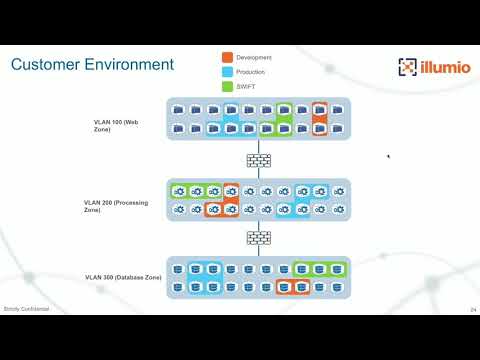
Illumio is a cybersecurity company specializing in Zero Trust Segmentation (microsegmentation), helping organizations contain breaches and ransomware by isolating workloads across data centers, cloud, and endpoints.